Observe first
See what is really happening — without trying to improve the result
For seven to fourteen days, record every serving as close as possible to the time you drink it. Note the type of drink, volume, strength, time and situation: where you are, who you are with and what happened just before you decided to drink. The first week does not need to be a successful week. It needs to give you an honest picture.
Counting glasses alone can be misleading. A large beer, a strong cocktail and a glass of wine may contain very different amounts of pure alcohol. Compare grams of alcohol or standard drinks, rather than only the names of the glasses.
How much
The drink's volume and strength tell you more than simply ‘one beer’ or ‘one drink’.
When
The times of the first and last servings show the pace and length of the evening.
In what situation
Company, place and emotions can reveal recurring triggers.
What happened afterwards
Sleep, mood, energy and next-day consequences show the fuller cost of the decision.
Cheers · How Cheers can help
Keep your own limits in view with alerts
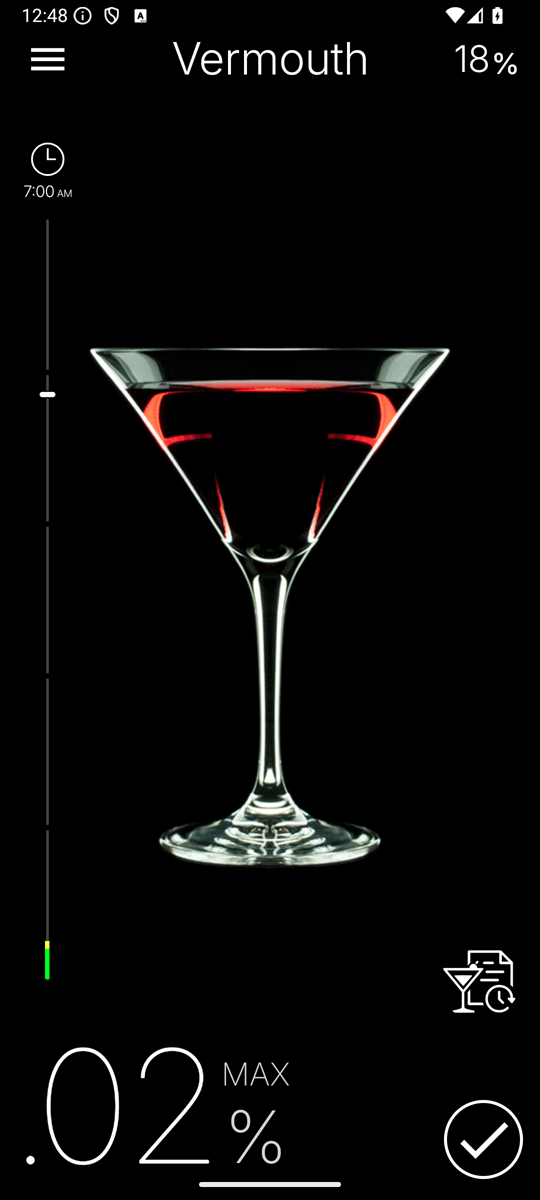
Set a target sober-time alert: Cheers warns you when another drink may push the estimated return to … beyond your chosen time — for example …. A separate maximum blood alcohol alert lets you know when the estimate is approaching the limit you set.
Less or none
A useful goal is specific without pretending to be a diagnosis
Instead of ‘I will drink more sensibly’, choose behaviour you can observe: a number of alcohol-free days, a maximum number of servings in one evening, a time to stop drinking, or situations in which you will not drink at all. Also write down why you are doing it — perhaps for sleep, health, relationships, training, money or calmer mornings.
For some people, abstinence rather than reduction is the right goal. This includes pregnancy, driving, some medical conditions and medicines, and situations in which repeated attempts to keep personal limits have not worked. In those cases, the safest goal is best agreed with a doctor or addiction specialist.
A plan for change
Four decisions to make before a difficult moment
A plan should reduce the burden when pressure, tiredness or an urge appears. It does not have to predict everything — it should point to the next achievable action.
Write down your reason and goal
One sentence about what you want to regain, and one specific rule for the coming week.
Choose a starting point
Pick a start date and plan the first situations in which you will use the new rule.
Choose two strategies
For example, record a serving before you drink it, have a non-alcoholic drink between servings and keep no alcohol at home.
Choose a person or place for support
Tell someone you trust what you are trying to do. Save the details of a doctor or service before you need them.
It is not only about willpower
A trigger can be avoided, weakened or waited out
An urge to drink often has a context. Recognising a recurring cue lets you prepare a response in advance, instead of starting a negotiation with yourself when the bottle is already open.
People and pressure
Prepare a brief ‘no, thanks’, order a non-alcoholic drink first or arrange to be with someone who knows your plan.
Place and availability
Do not keep a supply at home, change your shopping route or choose a meeting that does not revolve around alcohol.
Emotions and tension
Name the need beneath the urge: rest, relief, connection or reward. Prepare another response to that same need.
Time and ritual
If the cue is the end of work or the evening, plan the first 20 minutes: a meal, a walk, a shower or a call to someone.
A plan for a real evening
Make the plan easier to follow before the first serving appears
Choose two or three rules. A long list quickly becomes a test of perfection rather than a source of help.
Set the limit before you go out
Choose the number of servings and a time to stop drinking. Do not raise the limit during the evening.
Know the volume and strength
Cocktails, top-ups and large glasses may contain more alcohol than one item on a list suggests.
Slow the pace
Take breaks, have non-alcoholic drinks and do not order another serving before the previous one is finished.
Eat, but do not expect a shortcut
Food may slow absorption, but it does not remove alcohol or make the body eliminate it faster.
Arrange transport in advance
If you drink, do not plan to drive. An estimate and the way you feel do not confirm that you are fit to drive.
Have an exit plan
Write down who you will call and a simple way to leave if pressure or the urge grows.
When the plan does not work
One lapse does not have to trigger another
The most useful question is not ‘what is wrong with me?’ but ‘what happened just before my decision changed?’
Stop the chain
Look after your safety now. Do not try to ‘make the most’ of the rest of the evening just because the plan was exceeded.
Reconstruct the moment
Review the place, emotion, people, time and first decision that moved you away from the plan.
Change one thing
Add one specific barrier or source of support before the next similar situation.
Return with the next decision
Do not wait for Monday or a new month. You can restart the plan at the next possible moment.
The wider picture
Progress is more than the number of servings
Compare weeks, not individual evenings. Alongside the amount of alcohol, look at alcohol-free days, pace, occasions that ended according to plan, sleep quality, mood, conflict and spending. Sometimes the first important change is noticing earlier the moment when control would usually be lost.
If after several weeks you see no progress, hide your drinking more often, organise your day around alcohol or cannot maintain your own limits, do not simply add more rules. This is a good time for professional assessment and support.